By clicking “Accept”, you agree to the storing of cookies on your device to enhance site navigation, analyze site usage, and assist in our marketing efforts. View our Privacy Policy for more information.
Your preference will be stored for this browser and device. If you clear your cookies, your preference will be forgotten.
Stop paying for noise: reward referrals only after activation or paid conversion.
Match the incentive to your motion: credits/usage for PLG, revenue-aligned payouts for B2B, affiliate commissions for creators.
Build trust and sustainability: add eligibility rules, caps, self-referral blocks, and clear reward status so users keep sharing.
Table of contents
If you run SaaS long enough, you realize something slightly annoying: the channels that scale (paid, outbound, big partnerships) usually get more expensive over time, and the channels that convert (word of mouth) are the ones you can’t brute-force with budget.
That’s why referral programs keep coming back into fashion. Not because they’re trendy, but because they’re one of the few growth loops where your happiest customers do the selling, and the lead shows up already trusting you.
The problem is: most SaaS referral programs are either:
a “Share your link” widget nobody uses, or
a discount-fest that attracts deal hunters and fraud.
Let’s fix that. Here’s the modern playbook: why to do it, how to do it, and examples from SaaS vendors that are doing it right.
Why even bother with referrals?
A good SaaS referral program isn’t another marketing campaign. It’s a growth loop.
It gives you three things that are hard to get elsewhere:
Trust on day one: a referred lead doesn’t start at zero. They start with: "My friend uses this. It’s probably legit."
Better-fit customers: the best customers tend to refer people who look like them: same role, same problem, same taste.
Lower CAC without tanking your brand: you’re not shouting into the void. You’re rewarding customers for telling a story they’d probably tell anyway.
And if you build it well, referrals also improve retention because advocates feel invested.
Kinds of referral programs you can build
SaaS referrals is vague. In practice, there are 3 different animals:
User-to-user referrals: Best for freemium, self-serve, collaboration tools, prosumers. Typical rewards include productvalue (credits, storage, seats, usage).
Customer-to-company referrals: Best for B2B tools where adoption is team-wide, not individual. Reward include cash, gift cards, meaningful payout after qualification.
Affiliate/creator/partner referrals: Best for brands with content ecosystems, agencies, educators, influencers. Reward include commission, often recurring or time-based.
How to build a SaaS referral program that actually gets used?
1. Pick one clear moment to ask
Referrals work best right after the customer wins. Examples of "win moments":
They hit a milestone.
They upgrade.
They invite teammates already.
They give you a positive NPS/review.
2. Define the qualification events
Friend signs up is too weak in SaaS. You’ll get trash traffic.
Better qualification events:
Referee becomes an active user.
Referee becomes a paid account.
Referee becomes a qualified company (domain, team size, plan type).
Referee stays paid for X days.
Pro tip: if sales cycles are longer, consider a two-step reward:
Small reward at signup/activation.
Bigger reward after paid conversion or retention milestone.
3. Choose rewards that match your product economics
This is the biggest lever, and people still mess it up.
Great rewards for SaaS:
Credits (to unlock premium elements or usage).
Seats (add a team member free for a month).
Usage boosts (minutes, storage, extra exports, extra projects).
Plan upgrade trial (taste of premium).
Cash (for high-value B2B referrals, with stricter qualification).
What to avoid:
Big upfront cash for unqualified signups.
Generic discounts that train customers to wait for promos.
Rewards that feel unrelated to the product (unless your audience is very incentive-driven).
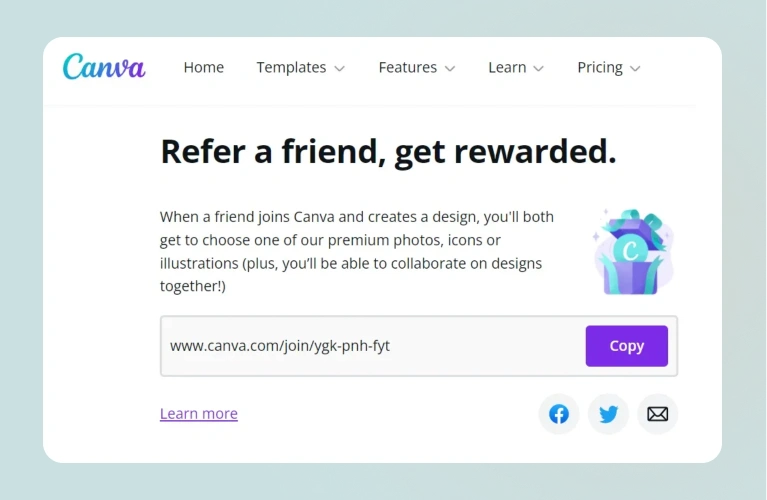
Canva’s referral program is a simple "invite friends, earn Canva Credits" setup: you share a personal link, and when someone joins through it, you get credits you can spend on premium design elements inside Canva.
Why it works:
Credits make Canva better immediately (no awkward cash vibe).
One link, easy sharing, no complicated steps.
The reward only matters if you actually use Canva, so it attracts real users, not coupon hunters.
Credits get spent while designing, pulling people back into the product loop.
Credits aren’t as farmable as cash, and they’re tied to real usage.
2. Miro
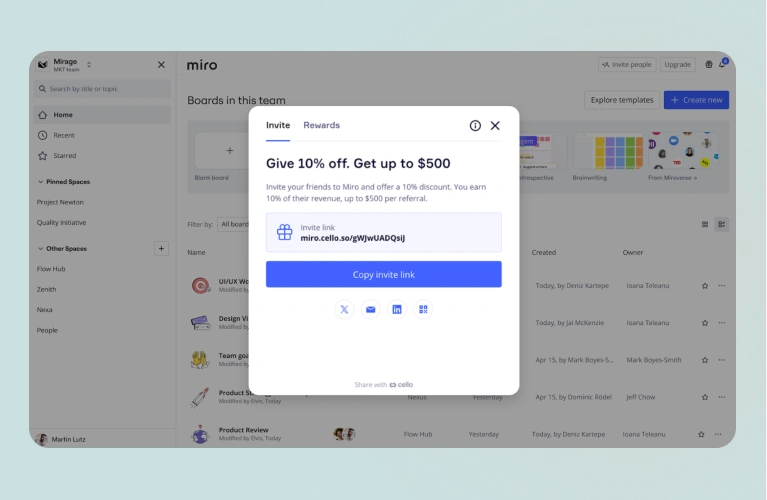
In Miro’s referral program, you share a referral link from inside Miro, the new team signs up with a work email and applies the code at checkout, they get a long-running discount, and you get paid as long as they keep paying, up to a cap.
Why it works:
It targets account adoption, not random signups: referrals must be a new company using a work email, and same-domain referrals don’t count.
Double-sided incentive reduces friction: the invitee gets 10% off for 11 months, so there’s a clear reason to use the code right away.
Payouts match revenue: the referrer earns 10% of monthly payments, so rewards scale with real value and stop when the customer stops paying.
Codes expire after 60 days, and eligibility rules prevent referring your coworker loops.
It lives right in the product dashboard, easy to find, easy to share.
3. Typeform
Typeform’s referral program is a clean "refer someone - they upgrade - you get paid" setup. You grab your invite link inside Typeform, share it, and when the person you referred subscribes to a paid plan, you earn $20 upfront plus 15% of their monthly subscription until you hit $500 total per referral (and payouts stop if they cancel).
Why it works:
Rewards trigger only when the referred user becomes paid.
The 15% monthly component tracks actual subscription value and naturally stops when revenue stops.
$20 upfront gives instant gratification, and the monthly cut keeps advocates referring higher-quality people.
The referral link is easy to find and copy from account settings, with share shortcuts (and a Rewards tab to track progress).
Self-referrals are explicitly not allowed, which prevents the most obvious “two accounts farming payouts” trick.
4. Webflow
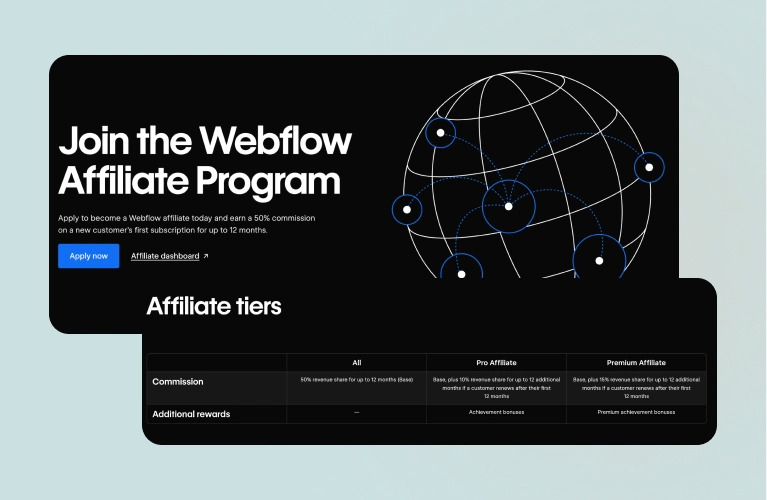
Webflow’s referral motion is really a creator-first affiliate program: it’s built for educators, influencers, bloggers, and template creators who can introduce Webflow to new audiences at scale. You apply, get tracked links via their affiliate dashboard, and you earn a chunky commission when a new customer subscribes.
Why it works:
Webflow advertises 50% commission on a new customer’s first subscription for up to 12 months, which is easy to understand and motivating for creators.
They call out a 90-day cookie window, which fits how people actually buy website platforms.
It’s explicitly aimed at content-led distribution. Agencies/freelancers are nudged to a different track (Certified Partner), so the program isn’t muddled.
No commissions for your own purchases (or anyone at your organization), and commissions apply to qualified subscriptions only.
Because it’s designed for cross-platform content, it can compound, one strong tutorial can send signups for months.
5. Grammarly
Grammarly’s referral program is the “share a link/code, earn a reward” kind of setup, but with one very Grammarly twist: it’s obsessed with eligibility and anti-abuse. You generate a unique referral link or code in the app/site, share it with people you actually know, and you only get rewarded if the person is genuinely “new-to-Premium” and completes a qualifying registration.
Why it works:
Referrals must be people who aren’t and haven’t been Grammarly Premium users (even via free trials). That stops discount recycling and keeps the program from being gamed.
A valid referral requires a qualifying registration process (including payment method if required) and email verification, so you’re not paying for low-effort signups.
Explicit bans on self-referrals, multiple accounts, bots/automation, and combining rewards with other offers.
Summary
In 2025, SaaS referral programs work best when they’re treated like a product growth loop, not a one-off campaign. The strongest programs reward real outcomes (activation, paid conversion, new account creation), use incentives that match the business model (credits for PLG, revenue-share for B2B), and include guardrails so you don’t accidentally build a fraud-powered discount machine.
FAQs
What’s the best referral incentive for SaaS—cash, credits, or discounts?
If you’re product-led, credits/usage usually win because they feel valuable and attract real users. If you’re B2B and referrals mean “new accounts,” revenue-aligned payouts are safer. Discounts are fine, but they’re easiest to abuse—so qualify them tightly.
How do I prevent people from gaming my referral program?
Gate rewards on meaningful events (activation or paid), block self-referrals, cap rewards, require verification (work email/payment where relevant), and track suspicious patterns like repeated devices/IPs or rapid-fire signups.
How do I know if referrals are actually profitable, not just “busy”?
Compare referred vs non-referred cohorts on activation, retention, and LTV—and calculate true CAC by including reward costs. If referred users don’t outperform baseline or cost too much, raise qualification criteria or adjust incentives.
Julia Gaj
Product Marketing Manager @Voucherify
Shapes how Voucherify talks about incentive optimization, from positioning and competitive narratives to campaign launches. Obsessed with modern marketing mechanics and what actually moves pipeline.
Notes on incentives, by Mike (our CMO)
Hot takes on loyalty & incentives.
Product updates that are actually helpful.
Monthly zodiac sign advice for your incentive strategy.
I don’t really get what Mike does, but if it helps people stop sending those awful ‘last chance!’ emails, then I’m all for it.


.webp)


.svg)


