

Loyalty programs have known about the household problem for years. They've just found it easier to ignore it.
Here's what makes it strange: in 2024, Netflix added 19 million subscribers in a single quarter, partly by cracking down on password sharing. Disney+ followed.
The message from the streaming industry was clear: shared access is a liability, not a feature. Meanwhile, Aeroplan was building pooled points for up to eight family members. JetBlue was letting friend groups share balances.
One half of the industry decided shared accounts were something to punish. The other half decided they were the most durable retention mechanic. The loyalty programs in the second camp are right, and this post explains why.
A household loyalty program allows multiple people to earn and redeem rewards through a shared account or pooled balance. The model reflects how people actually spend: collectively, not individually.
The most common setup is points pooling. Each member earns rewards through their own purchases, but points accumulate in a shared balance the household can use together.
Some programs use fully shared wallets. Others assign different permissions across members:
Household loyalty programs are especially effective in industries where spending is already shared by default: grocery, retail, travel, hospitality, telecom, and subscriptions.
Brands that engage entire households increase purchase frequency, retention, and share of wallet across multiple buyers instead of relying on a single customer relationship. According to Brandmovers, 75.7% of loyalty programs are planning to offer family-linked mechanics in the near term.
Many brands treat household loyalty and group loyalty as the same thing. That's a design mistake with real consequences.
Both involve shared rewards and pooled points. But they operate on completely different trust models, and confusing them creates friction in exactly the wrong places.
Household accounts are closed groups managing shared spending. Someone needs control over who joins, who can redeem rewards, how shared balances are used, and what happens when minors are involved. That's why household loyalty programs work best with invite-and-accept enrollment and controlled redemption rights. Because nobody wants the "wait, who spent 80 000 points on that?" conversation at dinner.
Group loyalty programs optimize for something else entirely: participation momentum. A sports team, workplace challenge, fan community, or fundraising campaign doesn't need governance. It needs low friction: QR-code joins, shared links, and open contribution flows.
If you're building for a household, govern it. If you're building for a community, remove every barrier. Applying the wrong model is how you end up with a program that feels either too loose or too bureaucratic for the people actually using it.
The strongest programs in this space don't just pool points. They make deliberate design decisions that compound over time. Here's what's actually worth analyzing:
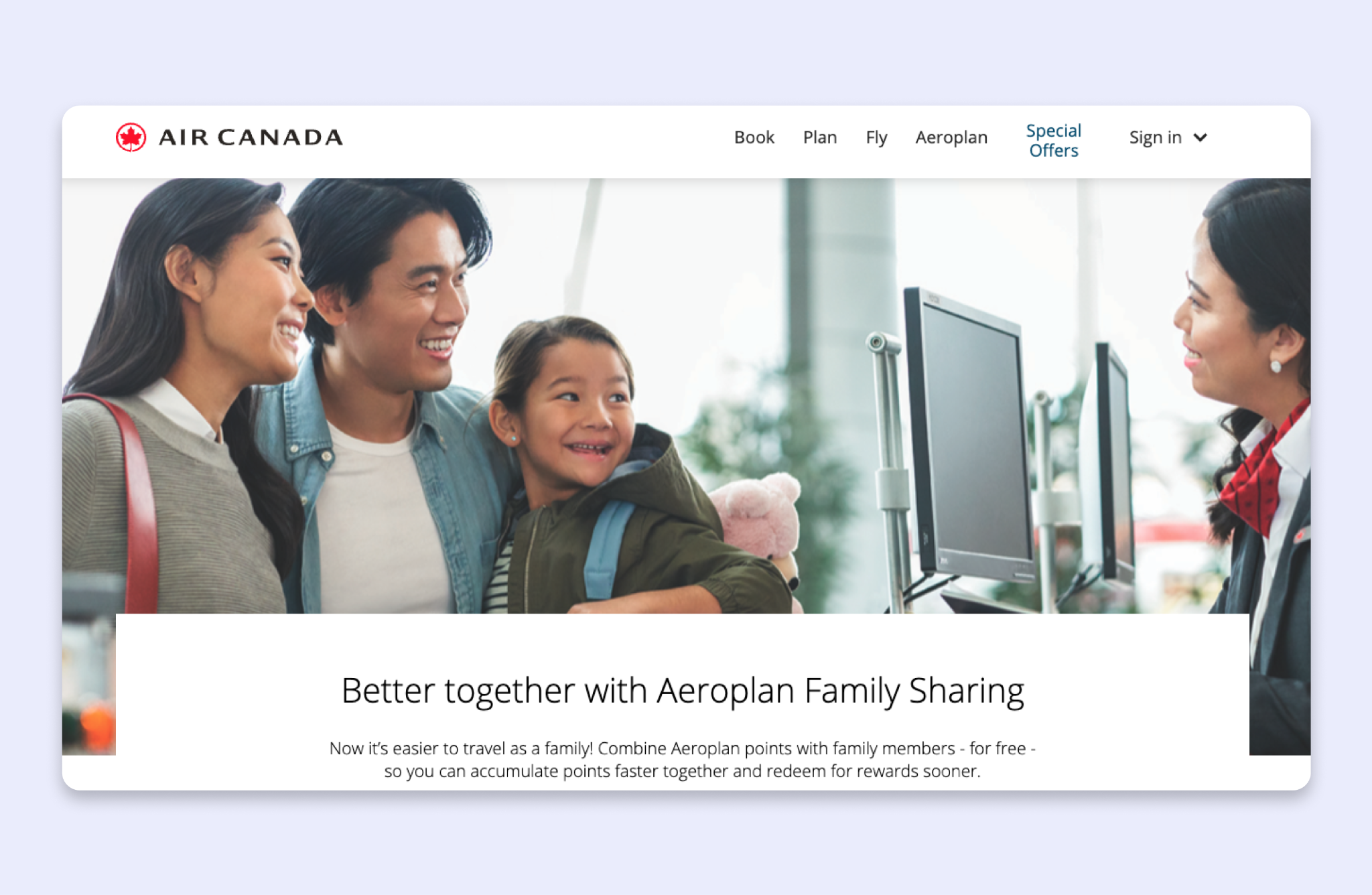
Aeroplan allows up to eight family members to contribute to a shared pool, with the Family Lead controlling redemption permissions. If any member holds an Aeroplan credit card, the entire household gets preferred reward pricing.
That last part is the smart design move. Points pooling is table stakes, but turning card membership into a household-wide benefit converts an individual financial product into a retention mechanism for an entire family unit.
Hilton Honors allows points pooling between up to 11 members, including friends and extended family, with annual transfer caps to reduce abuse.
The transfer caps are worth noting. In hospitality, one person typically books but multiple people benefit from the reward. The caps protect balance integrity without removing the benefit. That's a compliance and trust design decision embedded in the product, not added later.

Carrefour layered household-level personalization on top of family accounts, so the system learns from collective household behavior rather than individual transaction history. The result: offers that reflect shared routines instead of one shopper's history.
This is the most forward-looking model of the four. Points pooling is a retention mechanic. Household-level personalization is a data advantage. The grocery brands that build both are compounding two benefits at once: switching costs go up as the program learns more about how the family actually shops.
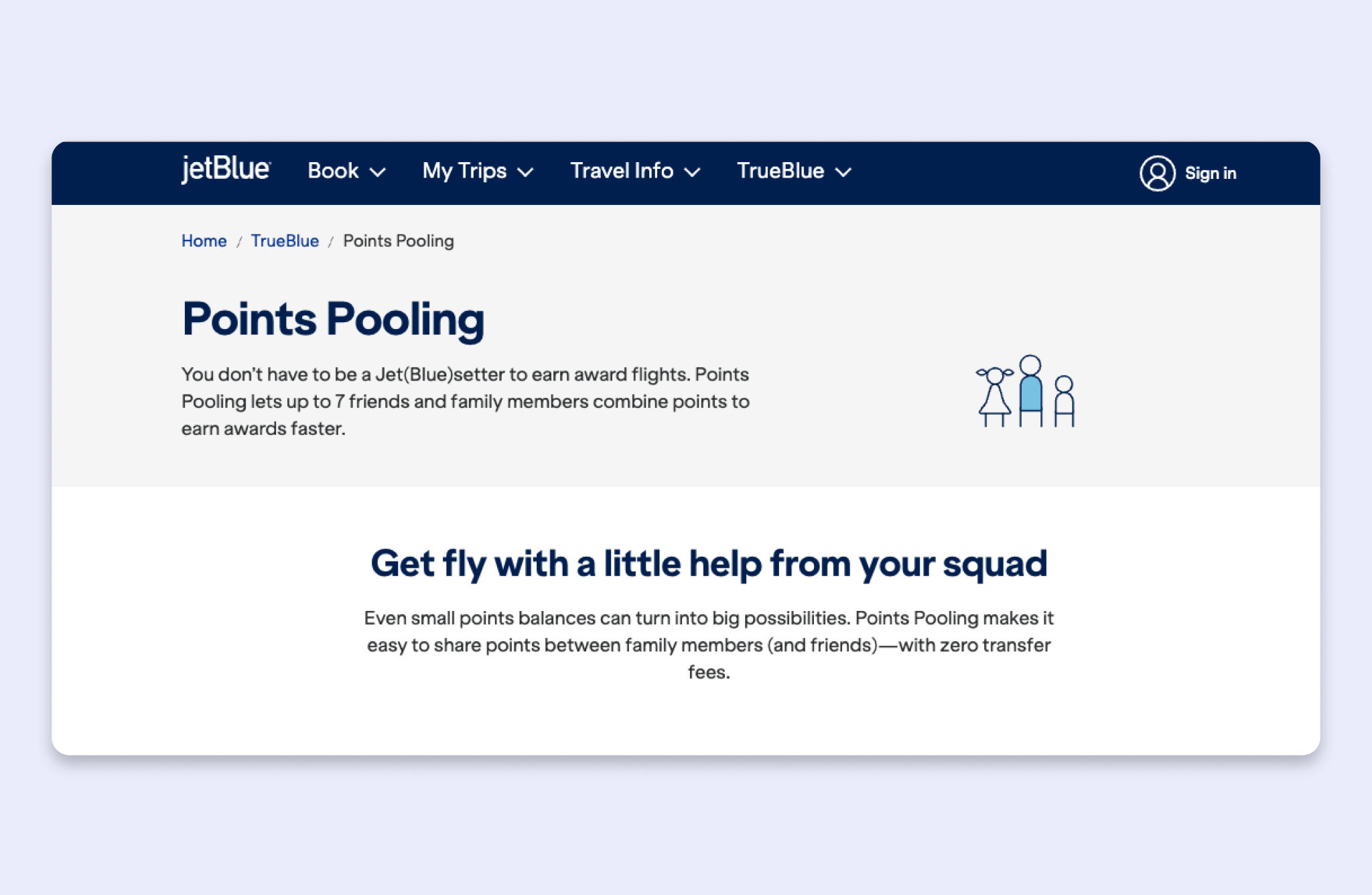
JetBlue's Points Pooling feature allows up to seven friends or family members to contribute to a shared account managed by a Pool Leader. Notably, JetBlue intentionally supports friend groups, not just families.
That's a deliberate product decision, not a default. By lowering the definition of household to include close friends, JetBlue expands the addressable relationship without changing the underlying pooling mechanic. It also makes the program work for demographics: younger travelers, urban renters, frequent flyers without dependents, who don't fit the traditional family-account model.
Learn more: What airline loyalty programs get right in 2026: mechanics that drive retention
Most household loyalty programs fail for operational reasons, not because points pooling is a bad idea. The problems usually appear after rewards start accumulating:
Earning is easy. Redemption is where trust breaks down. Before launching, define who can redeem rewards, whether all members have equal access, what happens when someone leaves the household, and how minors are handled.
These are not edge cases, they determine whether people trust the program at all. A family that discovers a teenager spent the shared balance will churn in a way that a standard individual-loyalty offboarding never produces.
Household programs need controlled enrollment: invite-and-accept flows, account ownership, member permissions. Group programs need speed: QR-code joins, shared links, open participation. Using the wrong model creates friction in exactly the wrong direction.
Many programs keep earning & spending thresholds built for individual shoppers. That doesn't hold up once you're pooling household behavior. If a family of four contributes to a shared balance, they should be hitting meaningful thresholds faster than any one of them would alone.
Household loyalty programs often involve shared accounts and minors, which introduces real regulatory requirements.
The 2025 COPPA updates, with compliance expected by April 2026, expanded rules around profiling and behavioral advertising for users under 13. Any brand building household accounts that include child sub-accounts needs verifiable parental consent built into the enrollment flow. It's a launch blocker if you skip it.
Most loyalty programs only capture one person inside a much larger spending unit. A family of four might shop at the same grocery chain every week while only one member actively participates in the loyalty program. That means three-quarters of the relationship stays invisible and unrewarded.
Household loyalty changes the math. Instead of rewarding isolated shoppers, brands engage the entire buying unit through shared balances, pooled rewards, and collective progress.
The retention effect is structural, not behavioral. You're no longer asking one customer to leave a loyalty program. You're asking them to break a shared household routine, take their spouse off the account, recalculate where to get the best points on weekly grocery spending. That's a much harder decision.
Single-shopper profiles are often a distorted picture of how a household actually buys. Grocery runs, refill orders, subscriptions, and travel bookings are shared behaviors distributed across multiple people. Tracking one member misses the pattern.
Household loyalty connects those signals. Offers start reflecting shared routines. Recommendations improve because the system understands household-level behavior, not just individual transaction history. Lifecycle triggers: when to offer a retention incentive, when to upgrade a member to a higher tier, when to push a co-branded offer, become far more predictable.
The Carrefour model is the right reference point here. The program learns from how the family shops together, not how one shopper buys individually. That's a data advantage that compounds over time and makes the program harder to replicate without the same underlying relationship.
The streaming industry just spent two years reminding everyone how much customers resent having shared access taken away. The brands in the other camp, the ones building shared balances as a core retention mechanic, not a workaround, are making the opposite bet: that the household relationship is the most durable loyalty relationship available, and that the infrastructure should reflect that.
Voucherify is building household and group accounts as native loyalty mechanics, because pooled rewards only work when the structure matches the trust model behind the group.
Learn more: We rebuilt our loyalty engine from scratch, here's why
The household loyalty opportunity has been visible for years. The problem was never demand, it was infrastructure, as most loyalty systems were built for individuals, so shared rewards became awkward add-ons instead of core mechanics.
The streaming crackdowns clarified the stakes. Platforms that punished shared access gained short-term revenue and burned goodwill. The brands building for shared access are accumulating something harder to replace: household-level habits, pooled balances, and collective routines.
The next retention advantage belongs to brands that treat the household as the real unit of loyalty, not an edge case.



.svg)

