

"Headless commerce" or "decoupled commerce" is a software architecture where the frontend and the backend are separated. This approach can be used almost in any area of ecommerce, for most software applications.
Headless commerce requires an app-based connecting layer between the frontend and backend where the communication occurs via API calls, which results in more streamlined architecture and produces less network traffic due to smaller payloads.
Headless Commerce is the current best-of-breed solution. Developers don’t build commodity software, like email systems, payment systems, booking engines anymore. They simply connect via API to best-in-class platforms that specialize in providing individual functions, or to the microservices necessary to deliver their chosen functionalities to the users.
Going headless is a major technological trend adapted by major software companies and consultancies:
Headless loyalty software is API-first loyalty platform that enables any software application to integrate loyalty functionality via API. Headless loyalty platforms are backend, designed to process any type of loyalty transaction in a manner that is decoupled from the frontend, customer-facing environment. This means, in simple words, that the logic, validation, redemption and tracking of the loyalty program will be managed by the API of the headless rewards software but the data to feed the loyalty program like, for example, product data, customer data will be pulled from your back-end (your CRM system or PIM system, for example). The loyalty program and its data, for example, number of points or available rewards, will be displayed on your front-end applications (mobile app, website, chatbot, you name it).
This is a graphic prepared by MACH Alliance that explains quite well where a headless rewards software is within a headless commerce architecture:
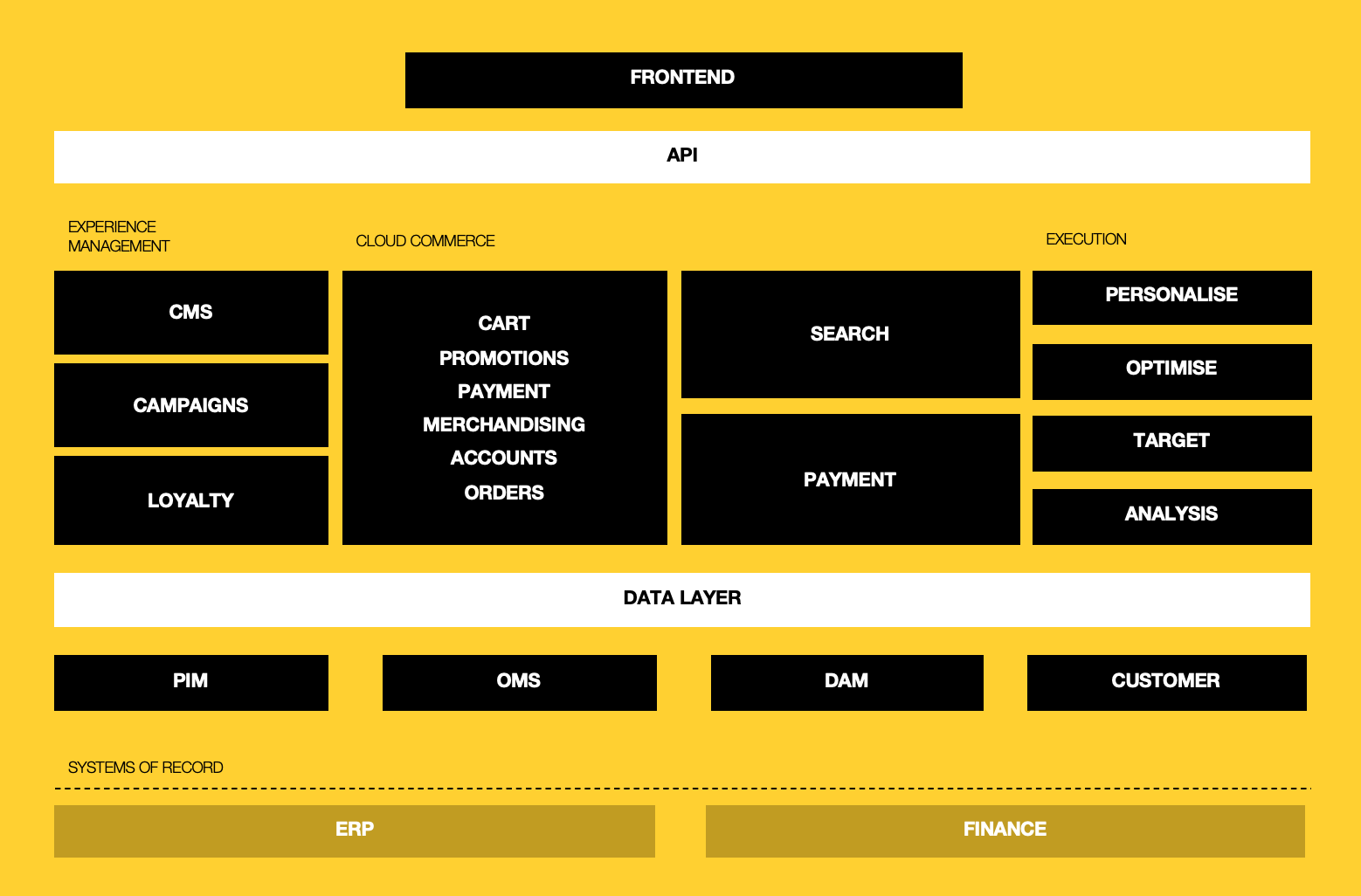
If you are wondering what a headless retention software should offer when it comes to features, read our post about the design of a loyalty software architecture where we cover a comprehensive overview of loyalty program features that matter.
In short, some of the features a headless loyalty software should cover are:
The ability to decouple the frontend from the backend gives much more flexibility when it comes to frontend platform choice, allowing for truly omnichannel distribution. It also allows for more flexibility in creating the frontend, as compared to rigid frontend solutions when using monolithic software. Having an out-of-the-box solution for the backend logic in place shortens the time-to-market greatly and saves a significant amount of money and time that otherwise would have to be spent on introducing a back-end logic. On the other hand, if you compare a headless retention software to an out-of-the-box monolithic (single-vendor) solution, it gives you much more options and flexibility when it comes to both features and frontend choice.
Reaching an infinite degree of flexibility that API platforms offer, if you plan to build it yourself, requires a great deal of investment which is simply not worth it if this is not your core business. Even if the initial investment cost might be comparable to the cost of paying a subscription over a couple of months, the real costs come with maintaining and upgrading the system. While you might think you will be fine with just 10 features at the beginning. With time, your needs will expand and as will your budget spent on building and maintaining such solutions yourself. Not even mentioning the hosting costs!
Instead of building features that can be readily available from a headless loyalty platform, your developers can focus on designing a scalable and responsive technical architecture, that will allow you to respond to market changes, new opportunities or risks, customer expectations, new distribution channels, sales channels or devices.
Thanks to having a headless retention platform in place, you gain a lot of agility. For example, if you need to change the program rules or available rewards quickly, you do not need to code a new set of rules and solve the edge cases yourself. You can do it with a couple of clicks on a dashboard or a couple of lines of request to the API and the API will change the back-end logic for you. You do not need to wait for the change to happen after another release round, you will see the changes immediately on the back- and front-end where the API is connected. The change will be effective on all platforms, mobile, desktop, social media – everywhere, where you use the API. No need to change the rules separately for each device or version. Such agility can be your competitive advantage on the market. In the future, this will be the baseline.
Thanks to out-of-the-box features of a headless retention platform, enterprises can ship their loyalty programs in minutes, once the initial integration is completed. This can help you respond faster to market opportunities and expand your operations by entering new markets or targeting new customer segments.
If your headless loyalty platform provider offers a dashboard to change the settings of your loyalty program, the loyalty program management can be handed over to non-technical teams, like Marketing or Sales. It makes much more sense as they are the ones designing the loyalty programs rules and related communication. It will also take the burden of managing loyalty programs off your developers' shoulders and let them focus on building the features related to your core business.
Headless loyalty solution uses open APIs with specific endpoints that are optimized for each specific use-case or business objective. An endpoint in an API is simply the end of a communications channel provided by the API, that allows a specific function to be completed. Hera are some use cases:
Decoupling the frontend from the backend, via an open API, greatly enhances extensibility to work with any other software apps in the technical architecture. Smaller data transmission payloads improve performance. The packets of information shared via API tend to be quite small, so congestion in the network is minimized as compared to monolithic solutions.
There are various benefits of implementing headless commerce. We’ll categorize the benefits and challenges according to the marketer, management, developer, and CTO perspectives.
Monolithic loyalty applications are:
They have a set of out-of-the-box features that have limited customization options. If you need something else, it might take weeks or months of your own developers to develop something on top of that platform, if possible at all.
It is expensive to adapt monolithic loyalty software for new sales channels. If the system provider does not do it, you will need to custom code it yourself. It will take time, it will cost money, and you may be far behind the competition once you reach that channel.
They often include much more features than you need, for example an in-built CRM system or campaign management for different platforms. You probably already have a CRM and campaign management platform in your stack and you do not necessarily want to migrate to another vendor. If you pay for a headless loyalty system, you should pay JUST for the loyalty functionalities and you can easily integrate and use the platforms you already have in place as data layers or distribution channels.
Monolithic solutions are often providing much more than just promotion management. As they do not specialize in loyalty programs, they might miss some use cases or relevant features. They may also upgrade their loyalty features less often than loyalty- and promotion-focused software.
Lack of integration capabilities with customer touchpoints, CRM and ecommerce software ecosystem leads to a simplistic approach to multi-channel customer journey, suboptimal rewarding schemes, and ineffective offer management in the enterprise context.
Monolithic loyalty software's shipping speed is slowed down by the following factors:
Legacy frameworks rarely have personalization built-in in their set of features. You may need a separate Customer Experience Platform or a Personalization Software to personalize your loyalty program and the integration of the database and features might be a colossal task.
Headless loyalty platforms can use any data you possess delivered via API to personalize your loyalty program. They can also fill in the loyalty data to your personalized messages crafted in your Customer Experience Platform.
If you have monolithic software in place or you have built your own loyalty solution, it can cause confusion and mutual misunderstanding with the tech team because small software changes take ages to complete. Marketing-required updates or changes are not implemented because they have a low priority level. This traction and frustration may cause inefficiencies in marketing-development collaboration.
What to watch out for when choosing a headless loyalty software provider:
In the end, the best loyalty stack is the one that works today and won’t limit you tomorrow.See our comparison of 15 enterprise loyalty software solutions and their key features.



.svg)


