

AI agents are starting to make buying decisions and they don’t care about your UX. They don’t see banners, pop-ups, or limited-time offers. They evaluate structured data: price, delivery, constraints and your incentives. In agentic commerce, incentives and loyalty programs aren’t marketing tactics anymore. They’re inputs into a decision engine and if they’re not machine-readable, they’re invisible.
The problem? Most brands still run incentives like campaigns: fragmented, channel-bound, and built for humans. But agents expect real-time, API-first logic they can query and execute instantly.
In this post, we break down how to make your incentives and loyalty programs actually work in an agent-driven world.
Agentic commerce is a model where AI agents evaluate, compare, and complete purchases on behalf of users, acting as the primary decision-makers in ecommerce.
In traditional ecommerce, users browse and decide. In agentic commerce, that evaluation is delegated to a system. Instead of a human comparing options manually, an agent:
AI agents don’t respond to persuasion (banners, urgency, UX patterns). They optimize for structured inputs like:
This creates a new competitive environment: machine-driven decision loops.
Mastercard frames the current evolution as AI agents finally "closing the loop" from search to purchase. We are moving away from the window shopping era and entering the era of transactional intent. But McKinsey adds a necessary reality check: this isn't a binary "on/off" switch. It’s an automation curve, and your incentives need to perform at every stage:
Agentic commerce is not binary. It operates on a spectrum:
This is where standardized protocols (like UCP and MCP) step in. They aren't silver bullets, they are the first real attempts to bridge that gap. And for a commerce team, the most critical bridge you can build right now is for your incentives.
Agent-first commerce is still early-stage, with limited production adoption and significant infrastructure gaps between AI interfaces and commerce systems. AI agents are not ready to run 100% of your checkout. Even major players have stepped back from pushing fully autonomous transaction flows into production, reinforcing how early this space still is.
What defines the current stage?
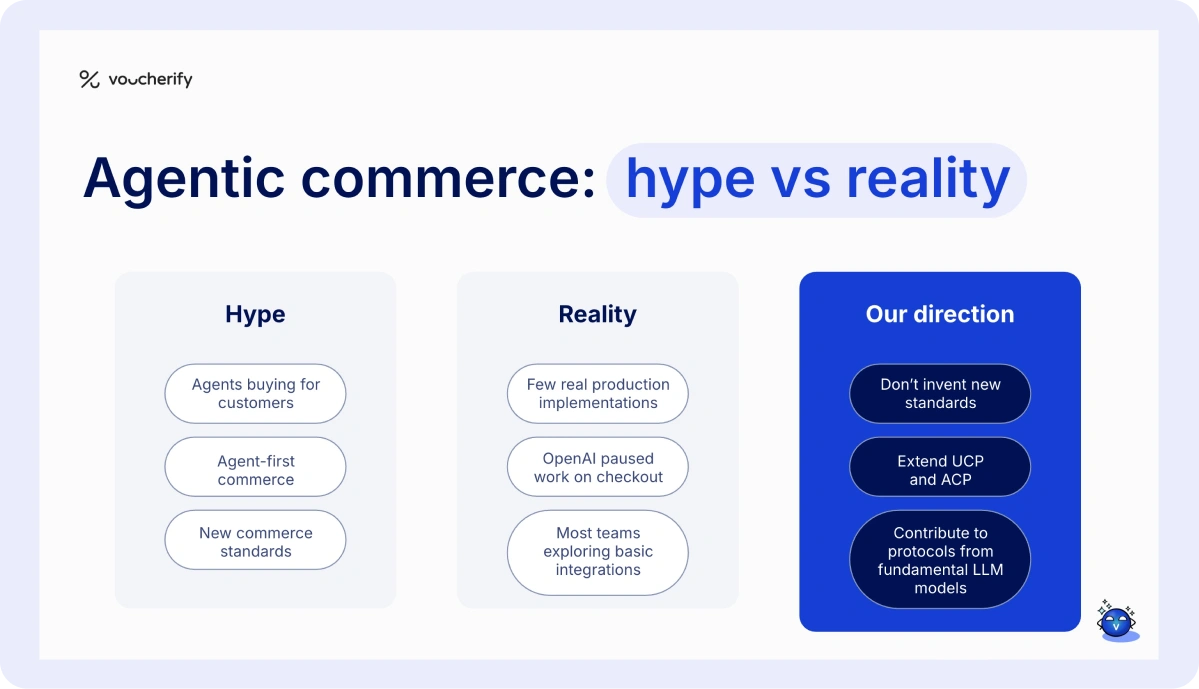
If you want the cleanest way to understand this shift, it’s this: traditional ecommerce optimizes journeys, agentic commerce optimizes decisions.
When you collapse the funnel, the metrics that used to keep marketers awake at night (like time-on-page or scroll depth) become irrelevant. What matters is how your value proposition survives a machine-mediated comparison.
McKinsey’s takeaway is blunt: if your value proposition is not machine-readable, you do not exist. Incentives are the most controllable, dynamic part of that value proposition. If you can’t expose them as data, you’re essentially opting out of the next decade of commerce.
Learn more: Why incentive optimization beats traditional promotions
To close this gap, new standards are emerging, such as UCP (Universal Commerce Protocol) and MCP (Model Context Protocol).
These protocols aim to:
We’ve already taken a deep dive into how UCP works, but the high-level takeaway for incentive strategy is this: commerce systems are becoming discoverable.
Instead of hoping an agent scrapes your site correctly, you expose a machine-readable manifest (like /.well-known/ucp). This tells the agent exactly how your system handles checkout, identity, and discounts. The shift is subtle but permanent. Incentives stop being something you show in the interface and become a system capability. They move from the UI layer into the core transaction logic: ready to be queried, evaluated, and executed as part of the machine-mediated decision loop.
%20(1).webp)
Machine-readable incentives are promotions and loyalty rewards that can be discovered, evaluated, and executed by AI agents via APIs.
In the UCP framework, the Discount Extension isn't just about applying a code; it’s about returning a structured result: what was applied, what wasn’t, and, critically, why.
For a human, an "Invalid Code" error is a minor UX friction. For an agent, it’s a dead end. To keep the machine moving, your system needs to return explicit, machine-readable reasons:
discount_code_expireddiscount_code_user_not_logged_indiscount_code_combination_disallowedThat why turns a failure into a feedback loop. Instead of stopping the transaction, the agent adapts. It can prompt the user to authenticate, adjust the basket to meet a threshold, or swap in a different incentive. In the agentic era, your incentive engine needs to be as much of a communicator as it is a calculator.
If your system can’t communicate these dimensions via API, the agent defaults to a guest view of your brand. You might have the best loyalty program in the world, but if the agent can't factor it into the initial utility calculation, you've already lost the rational buyer.
Imagine an agent comparing two offers:
A human might pick A based on headline savings. An agent calculates total value and often selects Store B. That’s the shift: headline discounts lose to structured value.
To compete in agentic commerce, incentives must be API-first, identity-aware, and designed for real-time evaluation by machines. If you want your brand to survive the decision loop of an AI agent, you can’t just rely on your existing tech. You need a specific architectural posture. Here is how you get your incentives agent-ready.
If an agent relies on manifests like UCP, your incentives cannot live in frontend logic or campaign-specific silos. They need to be exposed as capabilities that can be discovered and called programmatically:
If an agent cannot find your incentives via a protocol, it will simply ignore them.
Most incentive value is locked behind identity (loyalty tiers, member pricing). For agents, identity is not a post-checkout step, it’s part of initial evaluation.
If authentication is slow or fragmented:
Human users might guess why a code didn't work. Agents won't. If a discount fails with a generic “Invalid” message, the agent moves on. You must return structured, machine-readable reasons:
Pro tip: Incentives that can't explain themselves can't be optimized by AI.
Agents don't browse but query in bursts. Instead of a single user scrolling a page, you’ll see thousands of evaluation requests in milliseconds. Move toward a pattern of "Quote and Commit." Use a fast, stateless evaluation for the initial quote, and save the heavy-lifting validation for the final redemption.
Machines are much better at finding loopholes than humans. They can test combinations and edge cases at a scale you haven't seen before. You need a governed surface:
When the funnel collapses, clicks become a vanity metric. What actually matters now is your Inclusion Rate (how often you were in the consideration set) and your Acceptance Rate (how often the agent picked your offer). If your agent error rate is high, your tech is the bottleneck, not your marketing.
Most of the conversation around agentic commerce is focused on making incentives visible to agents. We focus on making them actually work.
At Voucherify, incentives aren’t treated as static objects to expose, they’re built as composable, real-time logic that can be queried, tested, and executed across systems. Because when an agent evaluates an offer, it doesn’t just need to “see” a discount, it needs to understand if it applies, why it applies, and what happens next.
That’s why our platform is API-first and built on a MACH architecture, with MCP-powered interfaces that let agents:
We’re also not trying to reinvent standards. Instead, we extend frameworks like UCP with real, production-ready incentive definitions, so loyalty programs, discounts, and rewards are not just machine-readable, but fully executable. And that’s what makes incentives usable in agent-driven commerce.



.svg)


