

If you sell shoes or fresh veggies, incentives are relatively easy to plan. People buy shoes every few months, groceries every week. There is a natural rhythm you can work with. But if you run a ride-sharing platform, scooter network, or flight booking app, the rules change fast. Demand is unpredictable, inventory expires, and purchases can be expensive, emotional, urgent, or completely unplanned.
That makes incentives harder to get right. A discount sent too early wastes margin, sent too late misses the moment. A generic offer does very little when plans change by location, weather, season, route, price, or plain old vibes.
Voucherify is an API-first incentive optimization engine used by brands like TIER, Tourlane, Blacklane and easyJet holidays to design, launch, and iterate on incentives. We've worked with dozens of leading travel and mobility platforms on these exact problems. Here's what we've learned.
Traditional incentives work best when customer behavior is predictable. Buy coffee ten times, get one free, collect points on every grocery trip, you get the gist.
That logic starts to show cracks in travel and mobility contexts.
A customer doesn’t book a flight every Tuesday because they are loyal. They book when they have a trip to take, a price they can tolerate, and enough confidence to commit. A rider does not open a scooter app because they want to collect points. Instead they open it because they are late, it’s raining, the scooter is nearby, and the price makes sense.
This makes traditional rewards a poor fit for three reasons.
So what do you do with all that? Stop running incentives altogether? No. You need incentive logic that adapts to context, not logic that assumes every customer walks the same path at the same pace.
To get there, you need to understand personas and journeys in two ways.
First, literally. Who is the customer? A daily commuter, an occasional traveler, a tourist, a business user, a price-sensitive rider, a family booking holiday flights?
Second, behaviorally. What journey are they actually in right now? Are they browsing, comparing, hesitating, rebooking, rushing, switching from a competitor, or about to churn?
A new user is not always an acquisition problem. A frequent rider is not always loyal. The same person can move through different journeys depending on timing, location, urgency, price, and intent.
Here are four lessons we've learned from travel and mobility teams that started building incentives around real customer behavior.
The short answer: Don't incentivize abstract loyalty. Incentivize the next meaningful step in the customer's actual travel pattern. Sequence incentives so that one completed action unlocks the next relevant offer, building a chain tied to real behavior rather than arbitrary timelines.
Travel and mobility brands often treat incentives like one-off nudges. "Here's 10% off. Come back sometime." That works when the next purchase is simple and frequent. It falls apart when every booking is a separate decision, because the customer is constantly weighing: Do I need this now? Is the price worth it? Is there a better option?
Blacklane, a global chauffeur service operating in over 500 cities across 60+ countries, had this exact problem. The service itself created loyalty. A great ride could leave a strong impression. But turning that experience into repeat booking behavior was harder because there was no natural purchase cadence.

A customer might book an airport transfer today, an inter-city ride next month, and nothing in between. Each trip has its own context, budget, timing, and intent.
"A single voucher is a transaction. A sequenced journey is a relationship. That shift changed how we think about the entire role of rewards at Blacklane." – Ioana Pascaru, Senior CRM Manager at Blacklane
So Blacklane moved away from one-off vouchers and started building sequenced journey incentives. Instead of sending a single discount and hoping it would drive another booking, the CRM team broke the journey into smaller steps. One completed booking could unlock the next incentive. That incentive could then guide the guest toward the next likely action, based on their actual travel pattern.
For example:
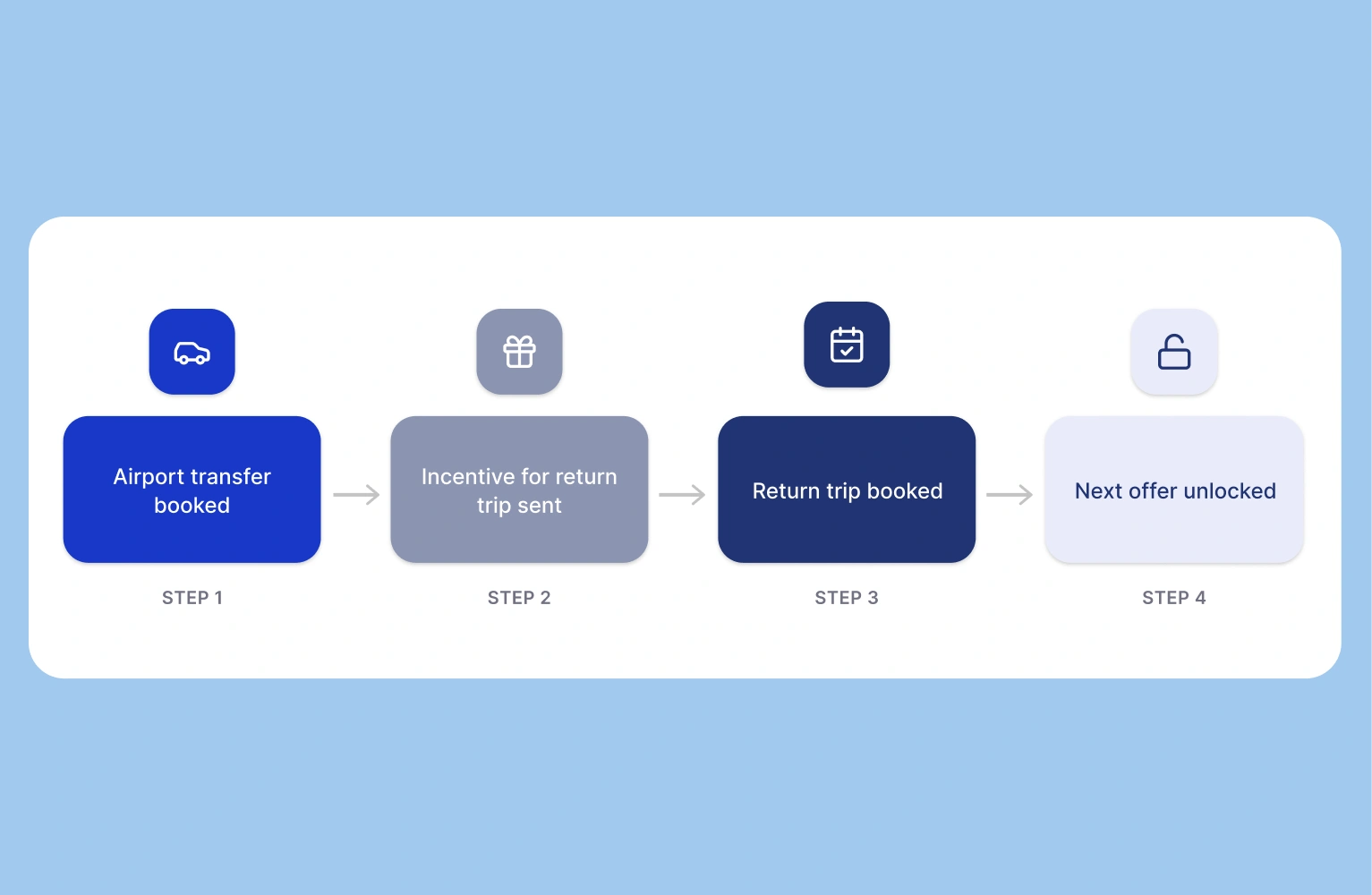
Blacklane's CRM team used Voucherify with Braze to configure these mechanics with far more precision than their previous in-house setup allowed. They could test incentives by voucher type, car class, budget cap, redemption limits, and journey stage, which gave the team room to experiment with incentive structures rather than guess.
And the results were not theoretical: Blacklane reported healthy conversion uplift, a double-digit increase in average revenue per guest, and 50% faster time to launch for new incentives.
The short answer: Generic promo codes are easy to launch but hard to control. They get shared outside the intended audience, redeemed in the wrong cities, and used by customers who would have converted anyway. Use metadata, segmentation, geofencing, and redemption limits to make campaigns precise before scaling them.
Generic offers are tempting. They are easy to launch, explain, and reuse across markets. The problem is that generic offers also leak quickly.
TIER Mobility ran into this problem at scale. The company operates across 260 cities in more than 20 countries, so promotions were not a side project. They were a core growth lever, especially when launching or expanding in new locations. But their previous setup created too much manual work and too many opportunities for error.
Teams had to fill sheets with codes. With hundreds of people involved across regions, that process did not scale. It slowed campaign creation, made troubleshooting harder, and increased the risk of mistakes. TIER also lacked the approval workflows and self-service controls needed for more than 400 users to manage campaigns safely across markets.
Voucherify helped TIER move from manual promo operations to a controlled incentive setup. The team could use metadata, segmentation, geofencing, approval workflows, and redemption limits to make campaigns more precise. Instead of relying only on generic ride discounts, TIER could configure product-specific incentives like unlocks and free minutes, attach them to customer profiles, and limit how long they stayed available.
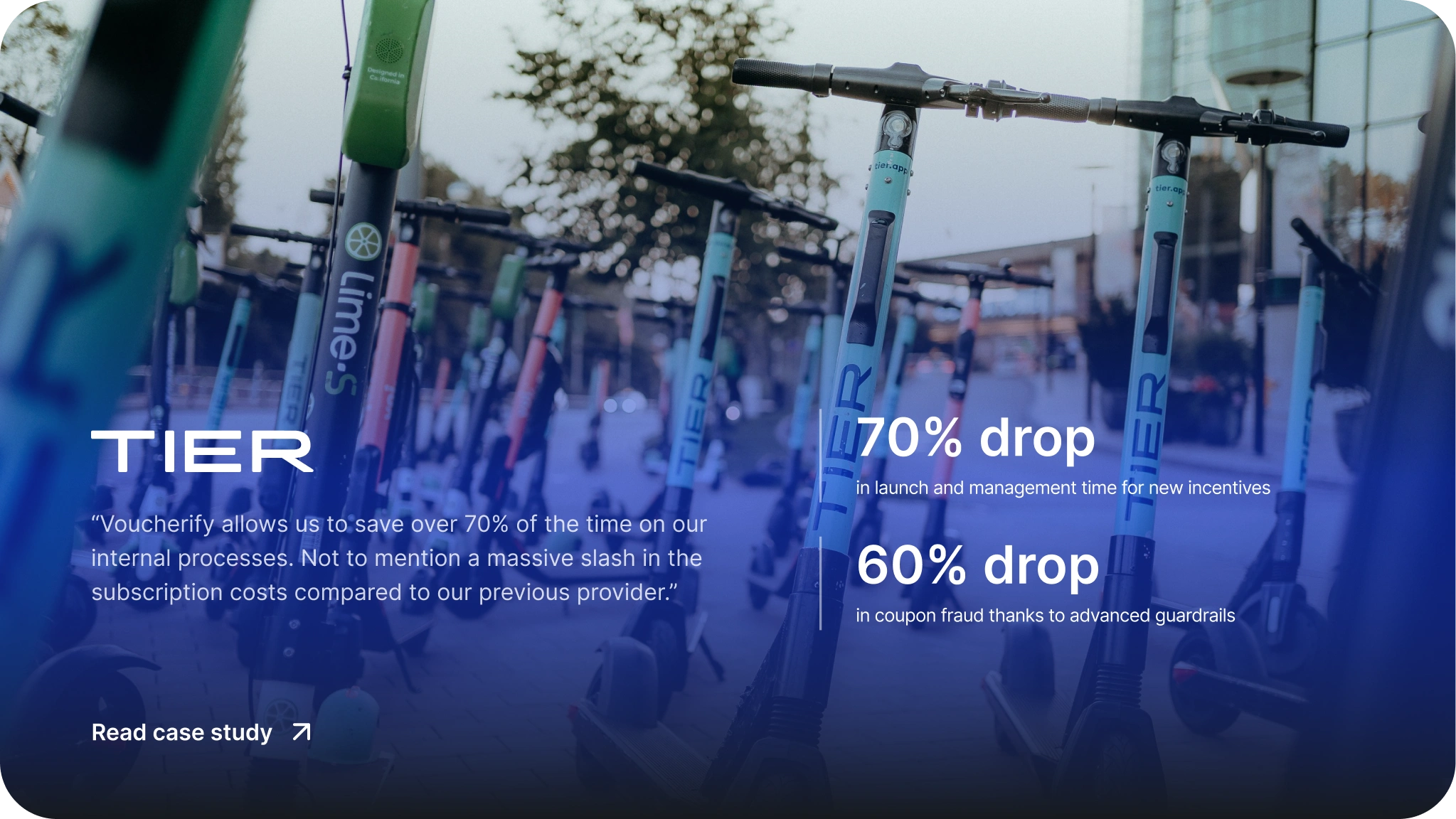
TIER reported a 70% drop in launch and management time for new incentives, a 60% drop in coupon fraud, and a 50% reduction in subscription costs compared with its previous provider.
The short answer: Your incentive system should support crisis response, not just planned campaigns. Refund credits, rebooking vouchers, and gift cards need to work at scale, automatically, and plug into back-office systems without custom engineering every time something goes wrong.
Everyone would love to leave Covid-19 in the archive folder and never open it again. Unfortunately, the world doesn't work like that. Pandemics, extreme weather, strikes, border changes, regional conflicts, safety scares, supply shortages, system outages, sudden demand drops. Travel businesses need to react fast when customer plans fall apart, and that reaction often depends on incentives.
Not the fun kind. The operational kind: refund credits, gift cards, rebooking vouchers, apology offers, retention incentives. Credits for customers whose trips were cancelled, delayed, or disrupted.
easyJet holidays faced this at the worst possible moment. The business launched shortly before Covid-19 forced mass cancellations across the travel industry. Marketing plans had to be put aside almost overnight. The priority became processing cancellations, protecting liquidity, and giving customers a reason to come back when travel restrictions were lifted.

Cash refunds were not the only option. easyJet holidays wanted to issue gift cards and refund credits that could be processed automatically and at scale. They needed incentive infrastructure that could plug into back-office systems, handle a surge in requests, and support a very specific use case under pressure.
Voucherify gave the easyJet holidays team an API-first way to automate refund credits and integrate vouchers into their existing systems. The complete integration took about 12 weeks, from first contact to the first refund processed through Voucherify. The setup helped them manage a heavy influx of cancellations while keeping refund credits usable for future bookings.
The short answer: Travel is one of the few categories where emotional loyalty is real. People remember great trips and talk about them. Attach your referral program to the post-trip high and you tap into word-of-mouth at the moment it's most likely to happen.
People remember great trips. They talk about them over dinner or send hotel links to friends. They recommend routes, cities, and hidden gems.
Tourlane, a Germany-based travel startup specializing in tailor-made trips, built its referral program around exactly that moment. Instead of trying to create loyalty from scratch, they tapped into the satisfaction customers already felt after completing a trip.
.webp)
Every traveler is automatically enrolled after their trip. They receive a unique referral code to share with friends and family who haven't traveled with Tourlane before. The referred traveler gets a 500 EUR discount, while the referrer receives a 200 EUR reward on top of their existing loyalty discount.
That's not a generic "share with a friend" pop-up on the homepage. It's a referral mechanic tied to a high-emotion journey stage: right after someone has experienced the product and is most likely to talk about it.
The results were hard to ignore. Tourlane reached 333% of its referral target in two months. Referred users converted at 80%. Referrals activated more than 15% of all CRM-sourced bookings.
That matters because paid acquisition in travel is brutal: search ads are expensive, Meta gets crowded, and comparison sites train customers to chase the lowest price. But a recommendation from someone who just had a great trip cuts through that noise without burning budget.
Travel and mobility customers don't move through neat funnels. They rush and compare and cancel and rebook; they switch cities, change plans mid-trip, travel for work on Tuesday and for family on Friday.
Blacklane shows why incentives should be sequenced around real journey steps. TIER shows why generic offers need strict controls before they scale. easyJet holidays shows why incentive infrastructure has to support disruption, not just growth. Tourlane shows how emotional loyalty becomes a low-CAC acquisition engine when referrals are tied to the right moment.
In travel and mobility, the right incentive is rarely just a voucher. It's a decision engine: one that understands context, responds quickly, protects budget, and helps teams test what actually moves customers from one step to the next.
If your team is still running promotions the old way, the cost isn't just in wasted margin. It's in every experiment you couldn't run because the system wasn't built for it.



.svg)


