

Most articles treat coupon stacking like a fun marketing trick: "Let customers combine discounts! More conversions! Bigger baskets!" Sure. And if you ignore the operational, economic, and technical machinery behind those combinations, you’ll also create the fastest path to unintentional margin suicide.
Coupon stacking is not inherently good or bad. It is simply powerful. And power without governance always breaks things.
This guide covers what coupon stacking is, why brands allow it, the economic and fraud risks it creates, how real retailers like Target and Kohl's govern it in practice, and what separates a promotion engine that protects your margins from one that quietly destroys them.
At the surface level, coupon stacking simply means that a customer can apply more than one discount, think two coupon codes, or a coupon code plus an automatic promotion, or a loyalty reward plus a free-shipping incentive.
But that’s the simplistic definition. The operational definition is much more interesting: coupon stacking is the controlled orchestration of multiple incentives through a hierarchy of rules, constraints, and economic logic that determines how offers interact at checkout.
Voucherify makes this orchestration explicit through campaign Categories and Stacking Eligibility settings. Every campaign can be assigned to a category with one of three stacking behaviors:
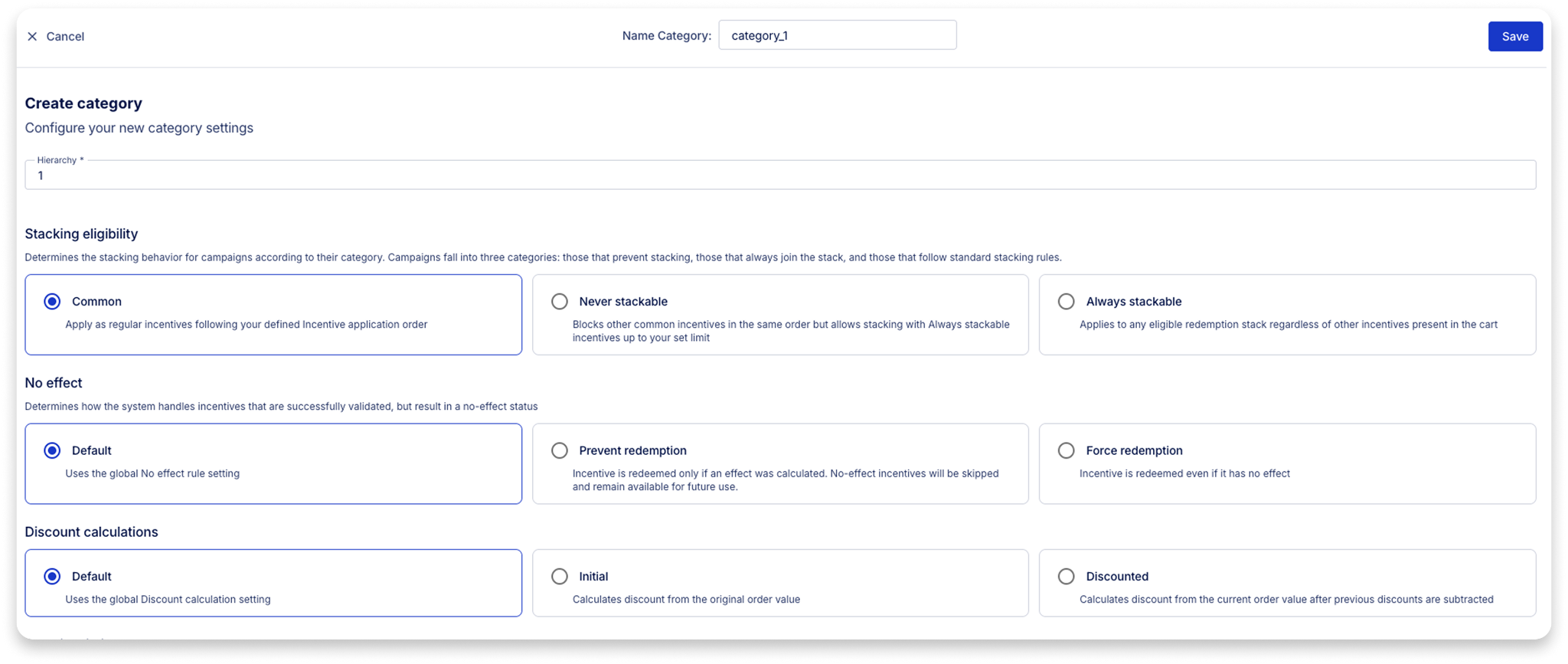
This maps directly to how real brands think about their offer hierarchy: loyalty perks always apply, exclusive sale codes never double up, and standard coupons follow the configured rules.
Allowing stacking means someone must make decisions about:
If these decisions aren’t pre-engineered, stacking becomes chaos.
When done intentionally and governed correctly, stacking can be extremely effective:
According to research, consumers respond better to separate stacked offers – "10% off your purchase, plus an extra 15% off with a coupon" – than to a single equivalent discount of "25% off." Stacking gives the customer a sense of building value. Each incentive feels like a win. The psychology is real and it works. But here's the thing: you decide which value they're allowed to build, not them. The moment stacking becomes customer-driven rather than rule-driven, margin evaporates.
Stacking always affects margin, sometimes gently, sometimes catastrophically.
Imagine a simple scenario:
That’s a pretty normal stack in brands without governance. Here’s what it really means:
Most operators don’t realise that combined incentives often push the order into negative contribution territory. So stacking must always be justified by incremental behaviour, not “higher conversion,” not “higher basket,” but incremental margin after incentives.
And if stacking can quietly torch your margins, it can also quietly multiply your risks. That's where things get really interesting.
Margin erosion is the obvious risk. But ungoverned stacking creates a much wider blast radius than most operators expect:
With Voucherify's Redemption rollback policy, you can control exactly what happens when a stacked redemption needs to be reversed: the Revert mode cancels the order and removes all applied discounts, while Keep mode preserves the discount history, particularly useful for handling refunds without losing the audit trail.

Here's the truth: stacking lives or dies inside the rule engine. Marketing doesn't run stacking. Your coupon engine does, and it's merciless. Every incentive either passes or fails. Valid or invalid. Applied or rejected. There's no nuance at execution time, only the rules you put in before it:
In Voucherify, stack depth is controlled via Global Limits – a set of hard caps you configure per project:

If you allow coupon stacking and the only number you report back to your team is “redemption rate went up,” hold up.
Let me paint the picture. A customer uses two stacked coupons. Your dashboard lights up. Conversion spikes. Someone calls it a “successful campaign.” But none of this tells you whether the money you spent on those discounts produced more margin than you gave away. You could easily have:
This is the dark side of stacking, and it’s invisible unless you measure the right things. Let’s walk through what mature teams actually track: the signals that reveal whether stacking is driving growth or quietly bleeding you dry.
Every experienced operator eventually learns the same difficult truth: Revenue lies. Orders lie. Only margin tells the story.
If a stacked incentive increases revenue by 12% but decreases contribution margin by 18%, you didn’t run a promotion, you ran a liquidation event. So the real question is: “Did we generate incremental profit that we wouldn’t have earned otherwise?”
This means comparing customers who received stackable offers versus a control group that didn’t normalized for seasonality, product mix, and pricing.
This way you ask: “Did we make more money from them than we would have without the stack?” If you can’t answer that, you shouldn’t be stacking yet.
Cannibalization is the villain that hides in plain sight. It’s the customer who absolutely would have bought anyway, full price, full margin, but you gave them stacked incentives anyway. When stacking is unrestricted, cannibalization quietly eats your P&L until you’re left explaining why your AOV looks great but your profitability doesn't.
Stacking shifts the gravity of the cart and if you don’t measure product mix, you won’t notice until it’s too late. Here’s what happens in reality:
The deal changes the psychology of shopping: “Hey, if I’m saving all this money, I can buy these low-margin essentials too.”
If you aren't tracking how stacking alters your product mix, you are letting customers become the promo architects:
Stacked incentives do something interesting to human behavior: They reduce purchase hesitation.
When discounts get heavy enough, customers stop thinking carefully. They buy impulsively. Then they return everything.
This is why mature promo teams track return rates per incentive pattern, not just per SKU.
If stacked transactions have:
then stacking isn’t driving growth, it’s driving regret.
When customers learn that stacking exists, and especially when they discover how generous the combinations can get, they change their behavior permanently.
They stop buying during non-stackable periods, set alerts for promotions, stockpile, and wait.
If your data shows these, you've created a promo addition:
These five signals won't all move in the wrong direction at once. But if two or three of them are trending badly at the same time, you have your answer. Stacking can be powerful – it can lift AOV, deepen loyalty, energize VIPs, reactivate lapsed segments. Or it can erode margins, distort product mix, inflate returns, and teach customers to buy only when the stars of discount alignment are perfect. Without measurement discipline, you won't know which path you're on.
Theory is useful. Real rules are better. Here's how five major retailers actually govern coupon stacking, and what their specific limits reveal about the decisions every brand has to make.
Target is an American retail chain that often offers a variety of discounts that can be stacked, such as manufacturer coupons, Target Circle offers, and Target RedCard discounts.
Kohl's, a US department store retail chain, allows their shoppers to save money by allowing for stacking coupons and combining them with other discounts such as Kohl's Cash program.
At Kohl's a maximum of 4 discount codes can be combined while placing an order online. There are also other rules to coupon stacking:
Bath & Body Works is an American beauty and personal care store that frequently offers coupons and promotions that can be stacked, such as buy-one-get-one-free deals and dollar-off discounts.

CVS is an American retail pharmacy chain where you can stack all sorts of coupons:
Similarly to Target, CVS allows for the usage of one manufacturer coupon (or other type of coupon/reward) and one store coupon per item.
A specialty retailer of crafts and fabrics based in Ohio, JoAnn Fabrics and Crafts allows their shoppers to make couponing a profitable experience and allows for generally using more than one coupons during transactions with a few exceptions:

Notice what every single one of these brands has in common: explicit rules, hard limits, and a clear hierarchy. None of them just "allow stacking." They govern it.
All the governance in the world means nothing if customers can't figure out how to actually stack their discounts at checkout. UX is the last mile of stacking — and it's where a lot of brands quietly fail.
Summer Salt gets it right: the coupon field clears after each code is applied, signaling to the customer that another code can be entered. The applied discount appears below, building that sense of accumulating value.

Pretty Little Thing makes the opposite choice: one code, then the field disappears and is replaced with a "change code" button. One coupon maximum, communicated through UI rather than a policy page.

Both approaches are valid. The point is intentionality. Whatever your stacking rules are, your checkout UI should make them self-evident, not something customers discover by accident or complain about to support.
Everything described in this post – hierarchy, combinability, SKU-level constraints, application order, depth limits – needs to live somewhere.
In Voucherify, it all lives in one place: the dedicated Stacking Rules section inside the Campaign Hub. No spreadsheets, no policy docs, no engineering tickets every time the rules change. Teams configure stacking behavior directly in the platform, and the engine enforces it automatically at validation and redemption time.
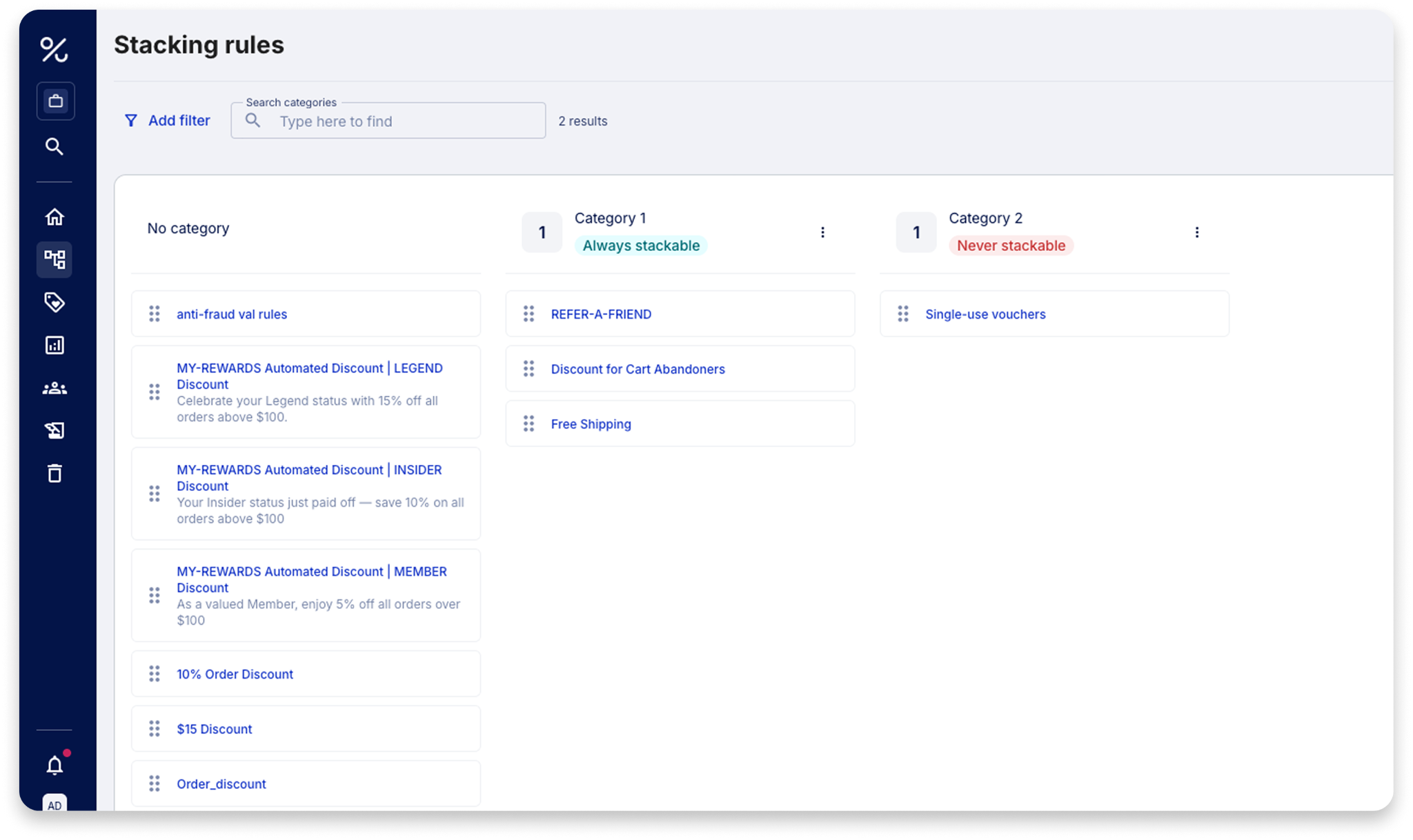
Here's what you can control:

Coupon stacking isn’t just “letting customers combine discounts.” It’s the controlled orchestration of multiple incentives inside a rules engine that decides what can be combined, in what order, for which customers, and under which economic constraints. Done right, stacking can boost AOV, strengthen loyalty, and deliver highly personalized checkout experiences. Done wrong, it can torch your margins, confuse customers, and create a flood of support tickets.
The real challenge isn't the coupons, it's the governance. And governance only works if it's enforced automatically, not written in a policy doc, not managed in a spreadsheet, not delegated to a developer every time marketing wants to run a new campaign.
Voucherify's Campaign Hub has a dedicated Stacking Rules interface, and this is where the real governance lives. Validation policies, application order, discount calculation mode, product-level stack behavior, rollback handling, global limits. All of it configured in one place, enforced automatically, no code changes required.
Marketing owns the rules. Engineering owns their sanity. And nobody wakes up to a margin disaster on a Monday morning.



.svg)


