

What is incentive marketing?
Incentive marketing is a strategic approach that uses targeted rewards to motivate specific customer actions at key moments in the customer journey.
Unlike traditional brand advertising, which relies on awareness or emotion, incentive marketing is explicitly value-driven. It provides a concrete reason to act by increasing the perceived value of an interaction, whether that is making a purchase, signing up for a newsletter, or referring a friend.
What is an incentive?
An incentive is a tactical reward used to trigger a specific action at a specific moment in the customer journey. For example:
- A personalized discount shown after cart abandonment
- Bonus loyalty points for completing a second purchase
- Referral credits unlocked when a friend converts
- Free shipping triggered for high-intent visitors
Effective incentives are context-aware and behavior-driven, designed to influence customer decisions without over-incentivizing. Rather than blanket promotions, they’re applied selectively, only when they create incremental value for the business.
Quick comparison: incentives vs. discounts
Understanding the distinction between a blanket discount and a behavioral incentive is key to protecting your margins.
Why incentive marketing works (the psychology)
Incentives leverage fundamental behavioral drivers to accelerate decisions customers were already close to making:
- Perceived value: the reward increases the attractiveness of the action.
- Loss aversion: limited-time or expiring incentives create urgency.
- Reciprocity: customers feel rewarded for engagement, fostering a positive brand loop.
- Progress motivation: tiers and milestones encourage users to complete a journey.
What role do incentives play in advertising?
Incentives turn passive interest into active conversion. By adding elements like free shipping or early access to an ad, brands can significantly lower their Cost Per Acquisition (CPA).
- Retargeting: re-engage high-intent users who abandoned their carts.
- Market Entry: use entry-tier rewards to stand out in crowded ad spaces.
- Urgency: limited-time offers increase Click-Through Rates (CTR) by leveraging FOMO.
Who uses incentive marketing?
It is a scalable growth lever across industries where acquisition and retention matter:
- Ecommerce & retail: for cart recovery and high-AOV (Average Order Value) triggers.
- SaaS & subscriptions: for feature adoption and churn prevention.
- Marketplaces: for two-sided referral growth (e.g., Uber, Airbnb).
- Fintech: for account funding and card utilization.
Types of marketing incentives
Incentives can be structured in various ways depending on the behavior you want to drive:
- Monetary: discounts ($ off, % off), cashback, or store credit.
- Engagement: loyalty points, tier upgrades, or early access to sales.
- Social: referral credits for both the advocate and the friend.
- Experiential: free shipping, mystery gifts, or VIP-only support.
- Gamified: spin-to-win popups or progress bars toward a reward.
Incentive marketing examples from real brands
Real-world brands use incentive marketing to bridge the gap between acquisition and long-term loyalty:
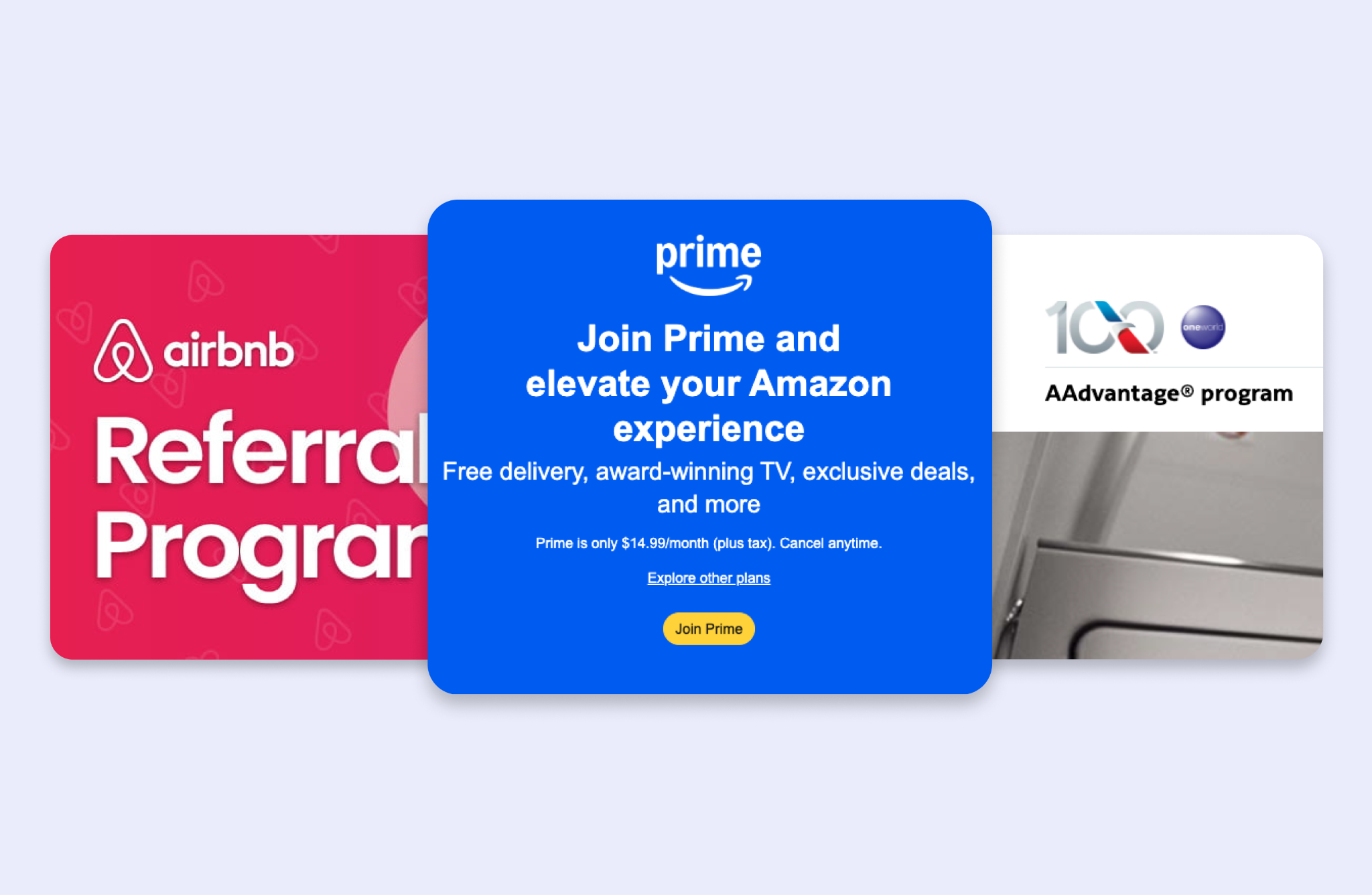
- Amazon Prime (value stacking): one of the most successful examples of incentive marketing at scale, Prime surpassed 200 million members globally by 2025. Its bundled model, including free shipping, exclusive deals, and streaming, uses a value stacking strategy to boost daily utility and make the membership feel indispensable.
- American Airlines AAdvantage (structured progression): the program leverages mileage-based rewards and tiered benefits like lounge access and priority boarding to drive loyalty. By requiring specific milestones (e.g., 40,000 Loyalty Points for Gold status), the structured progression motivates frequent flyers to consolidate their travel with a single airline.
- Airbnb (performance-gated referrals): airbnb’s referral program offers travel credits to both parties, but only after a completed stay. The two-sided, performance-gated model scales acquisition through social trust while maintaining strict cost control, driving high-quality leads without relying on broad discounts.
Best practices for effective incentive marketing
To maximize ROI your incentive strategy should follow these five principles:
- Personalize by behavior: tailor offers to lifecycle stages. A VIP shouldn't see the same reward as a first-time browser.
- Protect your margins: use guardrails like redemption limits and expiration windows to avoid over-incentivizing.
- Test the trigger: A/B test different formats. Sometimes free shipping outperforms a 15% discount.
- Measure incremental lift: don't just track redemptions; track if the incentive actually changed user behavior.
- Omnichannel orchestration: ensure the reward triggered via API in your app is consistent with your SMS and Email campaigns.
The future of incentive marketing
As customer journeys become more fragmented and purchase decisions are increasingly mediated by AI-powered agents, static, one-size-fits-all campaigns will no longer be enough.
The future of incentive marketing lies in real-time optimization: the ability to select, test, and scale the right reward for the right user at the exact moment of intent. Brands that treat incentives as a core operating system, rather than a seasonal tactic, will outperform the market by protecting margins while maximizing customer lifetime value.
Learn more: Loyalty programs are dead. Long live incentive optimization.
.svg)
