By clicking “Accept”, you agree to the storing of cookies on your device to enhance site navigation, analyze site usage, and assist in our marketing efforts. View our Privacy Policy for more information.
Your preference will be stored for this browser and device. If you clear your cookies, your preference will be forgotten.
When to award loyalty points: refund windows, cancellations and pending points
Julia Gaj
November 13, 2026
Award loyalty points when the purchase can no longer be undone, not when the card is charged.
Low-return businesses like groceries or food delivery can award points instantly. Fashion, electronics, and subscriptions should wait.
Table of contents
Why loyalty point timing is a margin problem
Picture a customer who orders three pairs of jeans, keeps one and sends two back. Your loyalty program paid out points on all three. Nobody did anything wrong, the program just counted too early. In my experience, that's how most programs are set up out of the box.
I've spent 8 years designing loyalty programs, and point timing is still the first thing I check when I look at one. It sounds like the most boring setting under the sun (it is), but it's also one of the most expensive to get wrong. When do points actually become points?
Most teams pick "at checkout" because it's the default, it feels generous and nobody wants to explain a delay to customers. Then finance runs the numbers on returned orders and the meeting gets very quiet (or loud, depending on company culture). Point timing isn't a CX setting, it's a margin decision. It decides whether your rewards fund revenue or subsidize returns, cancellations and the occasional creative customer. Below is how I'd pick the right moment, how long I'd wait for each type of business, and how I'd make the wait feel sweeter.
When should loyalty points become points?
TL'DR: let customers see points immediately, but only let them spend points once the purchase can't be reversed.
Earning and spending are two different moments. Every program I'd call well designed separates them:
Earned (pending): the customer completes a purchase or action. Points show up right away, but they're locked.
Active (spendable): the refund, cancellation or fraud window has passed. Points unlock automatically.
The critical cog here is the pending period. How long it should be depends on one question: how long can this purchase still be undone?
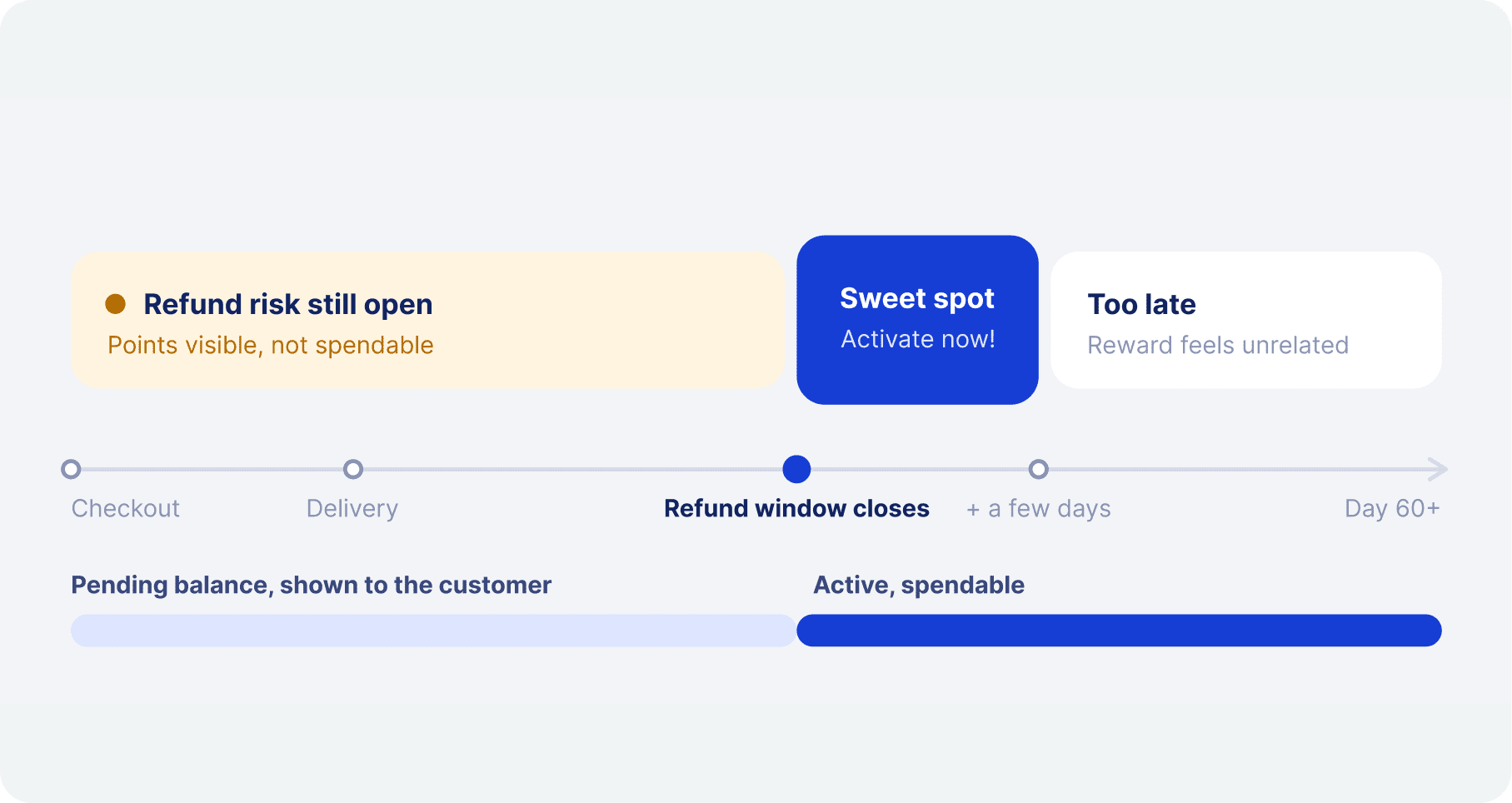
The rule of thumb I’d use: pending period = your refund or cancellation window + a few days of processing buffer. If the purchase can't realistically be undone, I'd skip the wait and award points instantly.
The cost of awarding loyalty points too early
Instant points look free until you add up the returns. Most loyalty programs have at least 2 of these leaks:
1. Points on revenue you never kept: Every returned order that earned points is a reward for a sale that didn't happen. If nobody claws them back, the customer keeps a discount funded by a refund.
2. The spend-then-return move: A customer earns points on order A, spends them on order B the same day, then returns order A. Now there's nothing left to claw back. Your options are a negative balance, an awkward support ticket or writing it off.
3. Points clawback friction: Even when points are still there, removing them is a manual job: someone has to match the refund to the right customer and adjust the balance. At volume, that's a nasty process and a source of mistakes.
4. Inflated loyalty liability: Outstanding points usually sit on the balance sheet as a liability: under IFRS 15 or ASC 606, they're typically treated as deferred revenue. Points issued on orders that later get refunded inflate that liability, so finance ends up reserving for rewards you shouldn't owe.
The cost of delaying loyalty points too long
So should you just delay all loyalty points by 60 days? I wouldn't. Points work because they're a reward and rewards lose power the further they drift from the action. A customer who buys today and sees nothing until next month doesn't feel rewarded, at best they’d be slightly annoyed.
Overly long waits cost you in quieter ways too:
The "where are my points?" tickets: Invisible points turn into support load fast.
A dead first impression: New members who join at checkout and see a zero balance have no reason to come back.
Missed momentum: If a customer is 50 points short of a reward and those points are stuck for 45 days, the nudge to buy again goes nowhere.
I'm never looking for the longest safe delay. I'm looking for the shortest wait that still covers the real risk, plus enough visibility that the wait doesn't feel like a wait.
How pending loyalty points work?
Pending points are points a customer has earned but can't spend yet. They're visible in the balance, they're clearly labeled, and they turn into regular points once a waiting period ends or a confirming event happens.
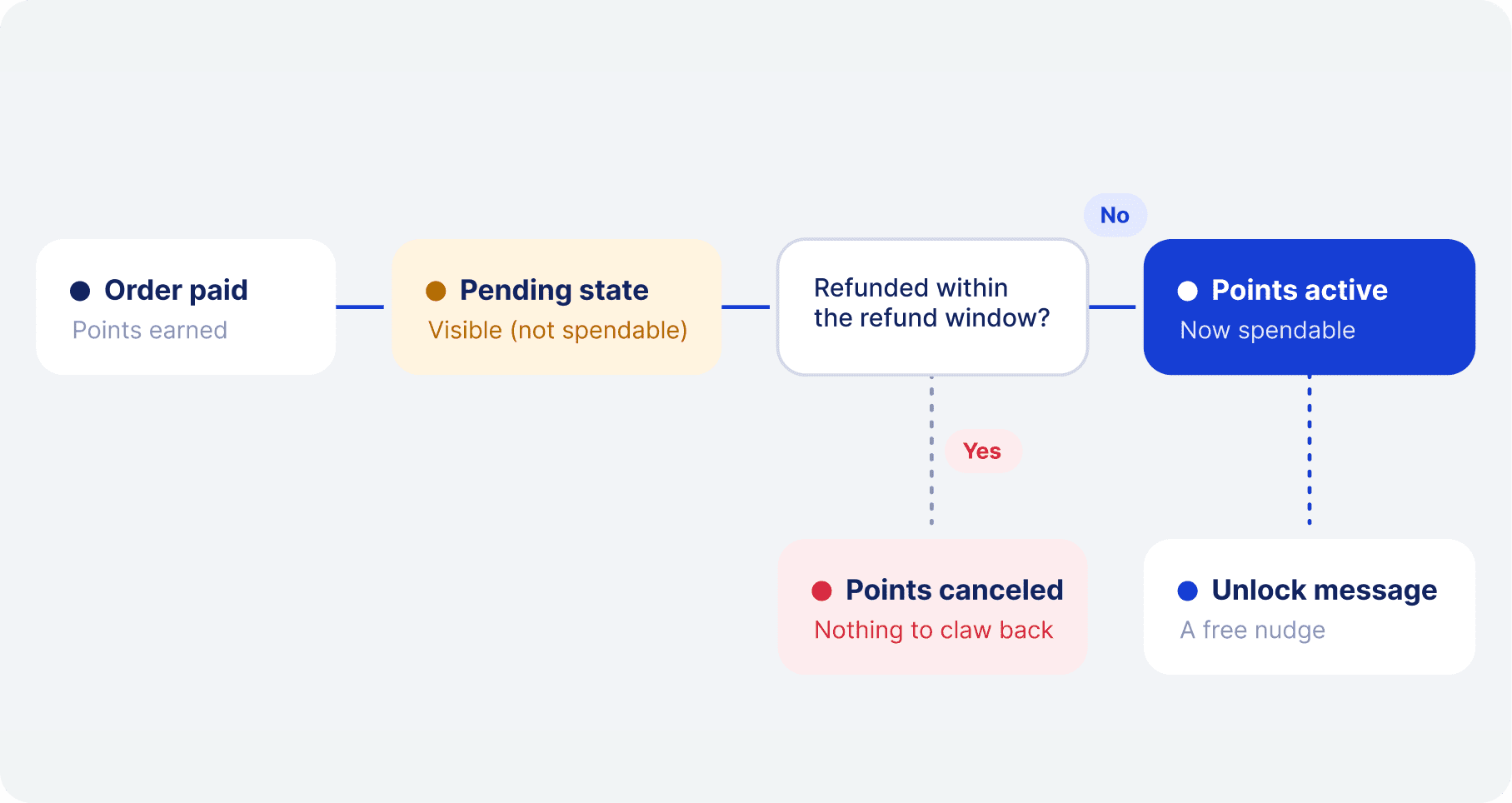
A pending point goes through a simple life:
Earned: An order is paid (or another qualifying action happens). Points land in a pending balance.
Waiting: The customer can see them, but can't redeem or transfer them.
Activated or canceled: If the purchase holds, the points become spendable. If it's refunded or canceled during the window, the pending points are canceled before they ever turn into real value.
Active: From here on they behave like any other points, and the expiration clock starts ticking.
How long should the pending points period be?
Match the pending period to how long the purchase can be undone, not to a number you picked once in a workshop. Here's a starting point by business model:
Returns, EU 14-day right of withdrawal for online orders
Legal or policy return window + buffer
Period-based
Groceries, QSR, food and meal delivery
Very little (order is consumed)
Instant, or on delivery for each order
Immediate or event-based
Travel and experiences
Cancellations up to departure or check-in
Activate after the trip happens, not at booking
Event-based (trip completed)
Insurance
Statutory cooling-off period
Cooling-off period + buffer (one insurer we spoke with uses 21 days)
Period-based
Financial products (loans, mortgages, cards)
Application falls through, loan never funds
Activate when the product is actually funded or closed
Event-based
Subscriptions
Free-trial cancels, first-cycle refunds
After the first paid renewal or the end of the trial
Event-based
Digital goods (eSIMs, software, gift cards)
Refund window, chargebacks
Match the refund window (e.g. 14 days)
Period-based
Marketplaces
Seller cancellations, buyer disputes
After fulfillment + dispute window
Event-based or period-based
For EU stores, the law sets a floor: online shoppers can cancel most purchases within 14 days without giving a reason, so a pending period shorter than that leaves points exposed.
Two patterns show up again and again:
Time-based risk (a return window, a cooling-off period) means a fixed pending period.
Event-based risk (the trip happens, the loan funds, the trial converts) means point activation on the event itself.
Not sure which you are? Look at when refunds actually happen in your data. If 95% of refunds arrive within 18 days, a 60-day pending period is just making people wait.
How to make pending points feel sweeter
A pending period is a UX problem, not a points problem, and you fix it by showing more, not by giving more.
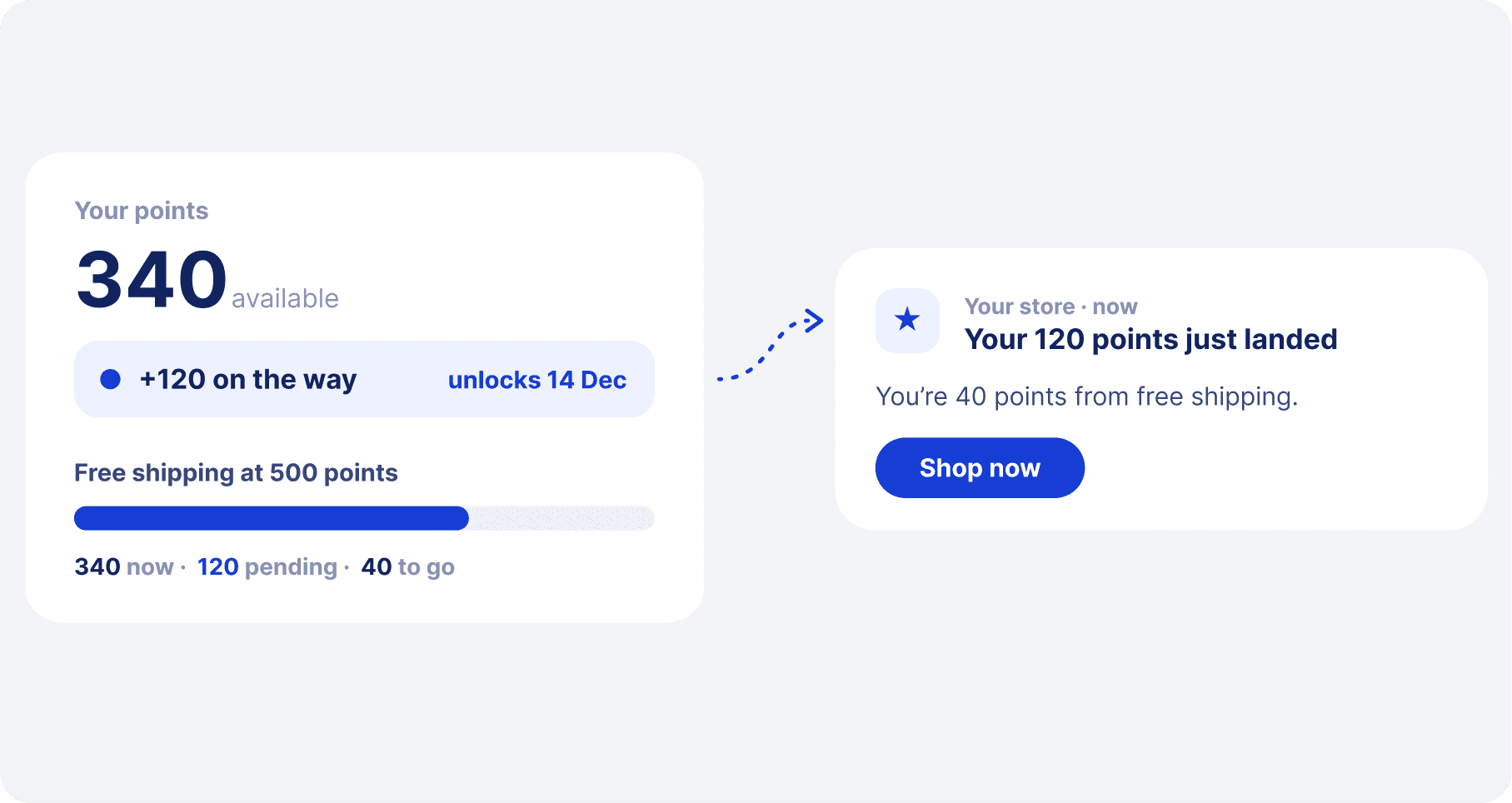
Show two numbers, always: "Available: 340 points. On the way: 120 points." A meal-delivery brand we work with is building exactly this: one counter for points already earned, one for points that land once the remaining deliveries arrive. Customers stop asking where their points are when they can see them.
Put a date on it: "120 points unlock on 14 December" beats "points are pending".
Make activation a moment: The day points unlock is a free reason to reach out. You'd pay for that re-engagement touch anyway.
Show progress at checkout: Include pending points in progress bars toward the next reward or tier. Showing them costs nothing, since they still can't be spent.
Reward low-risk actions instantly: Reviews, profile completion, app logins, award those immediately, so there's always something happening in the account.
Loyalty points on refunds, cancellations and partial returns
Pending points handle the easy refund case. The edge cases are where programs leak, so write these rules down before launch, not during your first Black Friday.
Scenario
Recommended rule
Why
Full refund inside the pending window
Cancel the order's pending points
Nothing was ever spendable, so nothing to claw back
Partial refund inside the window
Reduce pending points in proportion to the refunded amount
Customer keeps points for what they kept
Exchange (same value)
Keep the points as they are
Revenue didn't change
Refund after points activated
Deduct from the active balance
Same logic, just later
Refund after points were already spent
Decide: allow a negative balance, or write it off below a threshold
Chasing small amounts costs more than it saves
Order canceled before shipping
Cancel pending points immediately
Fastest, cleanest case
Chargeback or confirmed fraud
Cancel all pending points on the account and review active ones
Fraud rarely comes alone
A few more things worth deciding early:
Which amount earns points? Earn on what the customer actually paid after discounts, not the list price. Otherwise you're rewarding the discount you already gave.
Do pending points count toward tiers? Safest default: show them as progress, but only promote a customer once the points are active.
When does expiration start? From activation, not from the purchase. Otherwise the pending period quietly eats into the customer's time to spend, and your breakage estimates get skewed.
Who triggers the reversal? Refunds usually live in your order management or payment system, not your loyalty engine. Someone has to connect the two, or reversals stay manual forever.
How to set up pending loyalty points in Voucherify?
In Voucherify, point timing lives in the point wallet, the set of rules that controls how points are earned, stored, spent and expired. The pending points step offers 4 ways to time activation:
Pending type
How it works
Best for
Immediate
Points activate the moment they're earned
Groceries, QSR, low-risk actions
Period-based
Points wait for a set period: up to 90 days, 12 months or 1 year
Return windows, cooling-off periods
Fixed dates
Points activate on set dates (up to 20)
Monthly or quarterly release cycles
Event-based
Activation tied to custom events you send, like a trip completing or a loan funding
Travel, financial products, subscriptions
The bottom line
Points are a promise. Pending points just make sure you only promise what you've actually earned. Set the wait to match your real refund risk, show it to the customer and use the unlock as your next touchpoint. Your finance team will stop flinching every time someone says "loyalty".
Pending loyalty points are points a customer has earned but can't spend yet. They sit in the account, visible and labeled, until the refund window closes or a confirming event happens. Think of them as points in the waiting room.
Should loyalty points be awarded before or after the return period?
Both, kind of. Show the points right away, but only make them spendable after the return period ends. Customers get the dopamine now, and you don't pay out rewards on jeans that went back in the box.
How long should a pending points period be?
As long as your refund or cancellation window, plus a few days for processing. Fashion often lands around 30–35 days, electronics around 14–30, and groceries or food delivery can skip the wait entirely. Nobody returns a burrito.
What happens to loyalty points when an order is refunded?
It depends on timing. Pending points get canceled, active points get deducted, and points already spent mean choosing between a negative balance and a small write-off. Pick the rule before launch, not mid-Black Friday.
Do pending points count toward loyalty tiers?
Show them as progress, but only promote customers on active points. Promoting someone to Gold and demoting them a week later after a refund is not the VIP experience anyone signed up for.
Are pending points bad for customer experience?
Not if customers can see them. An "on the way" balance with an unlock date turns the wait into anticipation, and the unlock day is a free excuse to say hi again.
Can some points be instant and others delayed?
Yes, and they should be. Reviews, profile updates and app logins can't be refunded, so award them instantly. Purchases can, so they wait their turn.
Julia Gaj
Product Marketing Manager @Voucherify
Shapes how Voucherify talks about incentive optimization, from positioning and competitive narratives to campaign launches. Obsessed with modern marketing mechanics and what actually moves pipeline.
Notes on incentives, by Mike (our CMO)
Hot takes on loyalty & incentives.
Product updates that are actually helpful.
Monthly zodiac sign advice for your incentive strategy.
I don’t really get what Mike does, but if it helps people stop sending those awful ‘last chance!’ emails, then I’m all for it.